
Project Buffers Are Not Waste — They Are Risk Absorbers
Compressing schedules doesn't reduce project risk — it removes the capacity to absorb it. Why buffers are essential to realistic project planning.
KairoProject
Compressing the schedule doesn't compress the risks
When a project is deemed too long, the reflex is often the same: review the estimates, eliminate the slack, adjust the milestones until the plan "fits." On paper.
But what was just removed isn't inefficiency. It's absorption capacity.
That's the fundamental problem: disruptions don't compress. A supplier two days late, an approval that drags, a piece of information missing at the wrong moment — none of these events disappear because the schedule got tighter. They still happen. The only difference is there's no longer anywhere to put them.
In a schedule without buffers, every disruption has only one place to go: the delivery date.
What "fitting on paper" actually costs
Here is the classic scenario:
| Phase | What happens |
|---|---|
| Planning | Estimates are reduced to satisfy deadline constraints |
| Kickoff | The schedule looks realistic, teams commit to it |
| Execution | A first disruption occurs — supplier delay, technical issue, unexpected absence |
| Impact | No buffer available → the delay propagates directly to the delivery date |
| Closure | Project delivered late, even though the schedule "fit" at the start |
This is not a discipline or effort problem. It's a planning design problem.
The classic mistake
Removing project buffers doesn't make a project more efficient. It just makes it more fragile.
Why teams remove buffers
There are several reasons behind this reflex — often well-intentioned.
Deadline pressure: stakeholders want firm commitments and shorter dates. Buffers are perceived as an admission of slowness, even lack of rigor.
The illusion of control: a tight schedule gives the impression that everything has been mastered and optimized. It's reassuring in the short term.
Parkinson's Law: if a task has 3 days of slack, it often takes 3 extra days. That's true. But the answer to Parkinson's Law isn't to remove buffers — it's to move them.

What Critical Chain does differently
Critical Chain Project Management (CCPM) starts from a simple observation: variability is inevitable, but it can be managed intelligently.
Rather than diluting buffers into each individual task — where they get consumed by Parkinson's Law — CCPM concentrates those buffers into collective buffers, positioned strategically in the schedule.
The three types of CCPM buffers

Project Buffer
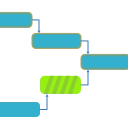
Feeding Buffer

Resource Buffer
The difference from traditional planning is fundamental: buffers are not hidden inside estimates. They are visible, tracked, and consumed transparently.
How to manage a buffer: the thirds rule
A buffer isn't managed by checking whether "green" remains. It's managed by tracking its consumption throughout the project.
The thirds rule is simple:
| Buffer consumption | Signal | Recommended action |
|---|---|---|
| 0 – 33% | Normal situation | No urgent action, continue monitoring |
| 33 – 66% | Attention zone | Identify causes, prepare corrective actions |
| 66 – 100% | Critical zone | Act immediately, escalate if necessary |
This table changes the project manager's posture. They no longer react when it's too late. They anticipate as soon as consumption crosses a threshold.
A concrete example: two projects, two approaches
Consider two similar projects with the same identified risks: a key supplier delay (60% probability), and a late internal approval (40% probability).
Project A — compressed schedule, no explicit buffer
- Supplier delivers 3 days late → 3 days lost from the final date
- Approval takes 4 days longer than planned → 4 additional days lost
- Result: 7 days late at delivery
Project B — CCPM schedule with a 10-day Project Buffer
- Supplier delivers 3 days late → 30% of buffer consumed, alert triggered
- Approval takes 4 extra days → 70% of buffer consumed, corrective actions engaged
- Project manager mobilizes resources early to compensate
- Result: on-time delivery, with 3 buffer days remaining
The buffer didn't prevent the disruptions. It gave the project the capacity to absorb them.
Key takeaway
A buffer is not an admission of inefficiency. It is what allows the project to hold when reality diverges from the plan. And reality always diverges from the plan.
What you can do right now
Changing your approach to buffers doesn't require rebuilding your entire project management system. Here are three practical starting points:
- 1
Audit your current schedules. List the projects that were delivered late and identify whether buffers were removed during planning. The connection is often obvious.
- 2
Distinguish individual margins from collective buffers. Encourage your teams to give realistic (not optimistic) estimates, then consolidate the margins into a visible buffer — rather than letting them dilute into each individual task.
- 3
Track buffer consumption, not buffer presence. A full buffer at kickoff is only useful if you know how fast it's being consumed. Set up weekly tracking and a threshold-based alert mechanism.
The buffer as a decision-making tool
The real change is as much cultural as methodological. As long as buffers are perceived as waste — or as a sign of weakness — they will be removed the moment pressure mounts.
But as soon as a project manager can show how their buffer is being consumed, explain why it is sized the way it is, and trigger alerts before the delivery date is impacted, the conversation changes.
The buffer is no longer a vague zone. It becomes a steering instrument.
This is exactly what KairoProject makes possible: real-time tracking of buffer consumption, actionable alerts when thresholds are crossed, and shared visibility between the project manager and stakeholders.
This buffer management approach is at the core of the Critical Chain method on which KairoProject is built.
2 minutes · personalized result
Newsletter
Want to go further?
Get regular, actionable takes on multi-project prioritization, the Critical Chain, shared resource constraints, and steering practices.