
CCPM: The Method That Explains Why Your Projects Slip (And How to Fix It)
What is CCPM (Critical Chain Project Management)? A complete guide to the Critical Chain method: principles, mechanisms, buffers, constrained resources, and multi-project steering for SMEs and engineering firms.
"We did everything right. So why is it still slipping?"
This is the question dozens of engineering managers, project leads, and technical directors ask themselves every week. The schedule was solid. The team is skilled. The deadlines were carefully negotiated.
And yet — the project is slipping.
This is not a skills problem. It is not a methodology problem. It is a systems problem.
The real issue is not inside the project itself. It is in the environment the project is operating in: a multi-project environment with shared resources, shifting priorities, unexpected urgencies, and portfolio decisions made without the project manager always knowing.
The project no longer lives in the world the schedule was built for.
This is exactly what CCPM — Critical Chain Project Management — was designed to address.
What is CCPM?
CCPM (Critical Chain Project Management) is a project management method developed by Eliyahu Goldratt and introduced in his book Critical Chain (1997). It is grounded in the Theory of Constraints (TOC) — a systemic approach that focuses on identifying and managing what truly limits a system's performance.
Applied to project management, this logic produces CCPM.
In one sentence
CCPM identifies the true limiting sequence of a project — accounting for available resources — and protects it with collective time reserves called buffers.
Where classical methods (PERT, CPM, traditional Gantt) focus on the logical chain of tasks, CCPM adds a critical dimension: resources are limited, shared, and their availability determines the real project duration.
The Problem CCPM Solves: The Multi-Project System
An Engineering Firm, 5 People, 6 Projects
Take a concrete example. An architecture or electrical design firm with a team of five people. Everyone is skilled, committed, and professional.
On paper, the organisation holds. Each person manages their tasks. Schedules exist. Weekly reviews happen.
But in reality, here is what unfolds:
- All five people are assigned to six projects simultaneously.
- Each project has its own lead, its own priorities, its own client.
- One project becomes urgent — an accelerated delivery, a pressing client. Part of the team shifts focus.
- The other projects slow down. Quietly, without any formal decision.
- A few weeks later, two more projects are running late. The team must choose: which one to sacrifice in order to save the others?
This scenario is not a symptom of poor organisation. It is the normal behaviour of an unmanaged multi-project system.
What the Schedule Cannot Predict
The initial schedule was correct. The durations were realistic. The task sequence was logical. But the schedule was built in a static world, while the organisation is dynamic.
What changes along the way:
- A resource shifts priority — the person planned for a critical task is pulled onto a project deemed more urgent.
- Another project becomes "priority" — without anyone formally assessing the impact on the others.
- A client approval is delayed — blocking one task, which blocks the next, which blocks a shared resource across two projects.
- A bottleneck appears — the most qualified person for a specific skill becomes the single point of passage for several projects at once.

Reassigned resource

Implicit priority

Invisible bottleneck
The problem is not in the calculation. It is in the dynamic environment the project enters once it is underway.
The Foundations of CCPM
The Critical Chain: What Really Determines When the Project Ends
In classical project management, the focus is on the critical path: the longest sequence of tasks, where a delay in any single task pushes back the project's end date.
CCPM goes further. It introduces the concept of the critical chain — which adds one more dimension: resource constraints.
The critical chain is the longest sequence of tasks that accounts for both logical dependencies and resource conflicts.
In practice: if two tasks require the same person at the same time, they cannot run in parallel — even if the project logic would allow it. The critical chain reflects this reality. The critical path does not.
| Critical Path (CPM) | Critical Chain (CCPM) | |
|---|---|---|
| Logical dependencies | ✓ | ✓ |
| Resource constraints | ✗ | ✓ |
| Individual margins | Per task | Removed → collective buffer |
| Suited to multi-project | Difficult | Designed for it |
Buffers: Replacing Hidden Margins With a Visible Reserve
This is one of the most counterintuitive — and most powerful — mechanisms in CCPM.
In practice, when someone is asked to estimate a task duration, they add a safety margin. It is human and rational: no one wants to be late on their own task. These margins are often hidden inside the estimate itself.
The problem: individual margins do not protect the overall project. They are consumed locally — by the student syndrome (starting at the last moment), by Parkinson's Law (work expanding to fill available time), or simply by everyday interruptions.
CCPM proposes a radical shift: remove individual margins and pool them into collective buffers, placed at strategic points.
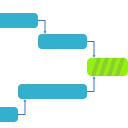
Project buffer
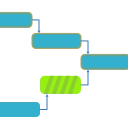
Feeding buffer

Resource buffer
What the buffer changes
With individual margins, each person protects their own task. With a collective buffer, the project is protected. The difference is fundamental: the buffer makes the reserve visible, measurable, and shared.
The Two Key Mechanisms for Multi-Project Contexts
1. Identifying the Constrained Resource
In any organisation, some resources are in demand everywhere. It is not necessarily the most senior manager. Sometimes it is the only person who masters a specific software, or the only engineer certified for a certain type of work.
This resource is called the constrained resource. In CCPM, identifying it is not optional — it is the foundational step of any serious steering approach.
Why? Because the speed of the system is determined by its constraint. If the constrained resource is overloaded, every project that depends on it slows down — regardless of intent.
In our five-person engineering firm, the constrained resource might be the only profile capable of running structural calculations, or the senior architect whose sign-off is required on every project. As long as this constraint is not identified explicitly, every schedule is built on uncertain ground.
Once the constrained resource is identified, CCPM recommends:
- concentrating effort to prevent it from being interrupted or split across multiple simultaneous tasks;
- subordinating all other decisions to the flow of this constraint;
- monitoring it as the first priority — its load and progress determine the health of the whole system.
2. Project Staggering
This may be the least-known CCPM mechanism — and yet one of the most impactful in a multi-project setting.
The natural temptation when managing several projects is to launch them all at once. Every client wants to start now. Every project feels urgent. The result: all resources are mobilised across all projects simultaneously, nobody makes real progress, and everything runs late.
CCPM offers a radically different answer: stagger the start of projects based on the availability of the constrained resource.
Fewer concurrent projects = faster progress per project = faster overall delivery.
It is counterintuitive. But it can be demonstrated: a system managing 3 projects in sequence delivers them faster than a system managing all 3 in parallel — because resources are not fragmented.
The intuition behind staggering
Think of a three-lane motorway. If 100 cars arrive at the same time, the traffic jam slows everyone down. If they arrive in a steady flow, each one moves at full speed. Staggering is about organising the entry flow of projects to avoid systemic gridlock.
How CCPM Works Day to Day
Tracking Buffer Consumption, Not Task Progress
In a traditional approach, the central question in project reviews is: "Where are we in the schedule?"
In CCPM, the question becomes: "How fast are we consuming the buffer relative to project progress?"
This is a major shift in perspective. The buffer is the project's health gauge. If it is being consumed faster than the project is advancing, that is an early warning signal. If it remains largely intact despite setbacks, the project is well protected.
This monitoring is traditionally done through a tool called the fever chart: a visual representation that positions each project according to its progress and buffer consumption level, in a green, orange, or red zone.
Priority at the Portfolio Level
In a multi-project context, CCPM introduces a dynamic priority logic: resource allocation decisions must be guided by the actual state of the buffers — not by client hierarchy or organisational habits.
The project whose buffer is most consumed relative to its progress is the one that deserves attention first — even if it is not the most strategically important one.
This is precisely the logic KairoProject applies directly in its portfolio dashboard. On opening, the tool displays:
- the portfolio under the most pressure;
- the priority project within that portfolio;
- the identified cause of that pressure;
- the recommended action, with the available levers.
From method to action
CCPM provides a reading framework. KairoProject translates it into a concrete decision: which resource to mobilise, on which project, and why.
CCPM vs Classical Methods: What Really Changes
CCPM does not reject the need to plan, estimate, or track progress. It changes how those activities are structured and interpreted.
| Aspect | Classical method (Gantt/CPM) | CCPM |
|---|---|---|
| Unit of tracking | Individual tasks | Collective buffer |
| Safety margins | Built into each task | Centralised as buffer |
| Resources | Often excluded from calculation | Integrated into the critical chain |
| Multi-project | Juxtaposition | Staggering and dynamic priority |
| Warning signal | Task delay | Buffer consumption rate |
| Steering decision | Reaction to delay | Anticipation on the constraint |
This is not a more complex method. It is a method that looks in the right places.
Is CCPM Right for Your Organisation?
CCPM delivers the most value in contexts where:
- multiple projects run in parallel with shared resources;
- deadlines are critical — contractual deliveries, client milestones, regulatory compliance;
- the organisation is human-scale — between 5 and 50 people — where every resource counts and margins are tight;
- forced multitasking is frequent — the same people move from project to project without visibility on the systemic impact.
It is particularly well suited to engineering firms, technical consultancies, design offices, and any structure delivering bespoke projects with a versatile team.
An important prerequisite
CCPM requires a cultural shift. Estimates without individual margins, trust in the collective buffer, priority driven by data rather than perceived urgency — all of this takes time to embed. But once the reflex is established, steering becomes structurally more serene.
What CCPM Does Not Solve Alone
CCPM is a planning and steering method. It does not replace:
- the quality of initial estimates (it improves them by removing biases, but does not generate data where there is none);
- project governance (strategic decisions, stakeholder management, contractualisation);
- human change management within teams.
It is also harder to implement well without a purpose-built tool. A classical Gantt chart does not easily support buffer consumption tracking, constrained resource visualisation, or project-by-project tension comparison. This is precisely why tools like KairoProject were built.
To go deeper on the real reasons projects drift, read our analysis of the true causes of delays in multi-project contexts.
Frequently Asked Questions About CCPM
CCPM and agile methods are not opposites. Agile manages uncertainty through short iterations. CCPM manages resource constraints and overall deadlines. In an engineering or design firm context — where deliverables are often contractual and resources are shared — CCPM adds a portfolio steering layer that agile alone does not provide.
The technical setup can be fast — a few days to a few weeks to configure projects and resources in an appropriate tool. Embedding the new steering culture typically takes 2 to 3 months to become a genuine team habit.
The core principles of CCPM can be understood in a few hours. Independent implementation typically requires a short training — 1 to 2 days — and some support during the first weeks of application. KairoProject is designed to make this practical adoption accessible without lengthy onboarding.
CCPM was developed by Eliyahu Goldratt, an Israeli physicist and management consultant, and presented in his business novel Critical Chain in 1997. It builds on the Theory of Constraints (TOC) he formalised in The Goal (1984). CCPM is today recognised by the PMI (Project Management Institute) as a fully-fledged project management approach.
Go Further
CCPM is at the heart of the method applied in KairoProject. If this guide has given you a solid first understanding of its mechanisms, here are the natural next steps:
- Discover how KairoProject applies CCPM in practice — buffers, constrained resources, portfolio priority.
- Read why too much information undermines decision clarity in project steering — and how CCPM structures useful information.
2 minutes · personalized result
Newsletter
Want to go further?
Get regular, actionable takes on multi-project prioritization, the Critical Chain, shared resource constraints, and steering practices.
Read next
Why projects slip even when everyone is working hard
An operational reading of delays when priority, flow, and the constraint remain implicit, with a real-world agency case and an actionable decision framework.
Project Steering: Too Much Information, Too Little Clarity to Decide
Full dashboards, weekly status updates, regular meetings — and yet decisions remain unclear. A real-world construction case and a method for surfacing the information that actually steers a project.
Deliver Projects on Time Without Burning Out Your Teams: What the Theory of Constraints Really Changes
The Theory of Constraints (TOC) applied to multi-project management: a proven method to rationalize flow, prioritize resources, and deliver on time without sacrificing quality.
Some Resources Are Overloaded: What Should You Actually Do?
Your team is overwhelmed and projects are piling up. How to detect resource overload, reassign without breaking other projects, and manage capacity across a multi-project environment.
Reducing Multitasking in Your Projects: The Right Management Approach
Multitasking in project management is not a concentration problem — it is the symptom of a portfolio without clear rules. Here is what the executive can decide, and what the project manager can do day to day.
How to Reduce Project Duration Without Sacrificing Quality
Your client wants earlier delivery. Before asking for overtime or cutting review stages, read this guide. Three concrete levers to reduce project duration without sacrificing quality or burning out your team.