
Why Projects Are Always Late: The 7 Real Causes
Why do projects always run late? Discover the 7 structural causes of project delays — and the concrete levers to catch them before they derail.
KairoProject
The status meeting starts. Someone speaks up: "We've fallen behind on this deliverable." Everyone nods. Nobody is really surprised.
Project delays have become so commonplace they are almost accepted as inevitable. Yet projects don't slip by accident. They slip for structural reasons — often the same ones, from one project to the next, from one team to another.
Naming those causes is already a way to regain control.
What you'll find in this article
The 7 most frequent causes of project delays, explained with concrete examples — and for each one, a realistic lever for action. Not empty theory: mechanisms you'll likely recognize from your own projects.
Cause #1 — Excessive Multitasking
This is the most widespread and least visible cause. Your key resources are assigned to five projects at once. Each one moves a little. None moves meaningfully.
The problem isn't a lack of work — it's fragmented attention. Every context switch costs time. Every interrupted task generates waste. And since everyone is "busy," nobody sees the problem.
| Visible symptom | Underlying cause |
|---|---|
| Key resources perpetually overloaded | Too many active projects at the same time |
| Delays creeping across all projects | No explicit priority between projects |
| Chronic sense of urgency | No sequencing of assignments |
The lever: reduce the number of simultaneously active projects and sequence assignments. One priority project fully advanced is worth more than five projects at 30%. If the same names keep showing up as bottlenecks across projects, that's usually resource overload across multiple projects — worth diagnosing before reshuffling assignments.
In a multi-project environment, the real constraint isn't total available time — it's the ability to concentrate that time on what matters.
Cause #2 — Overly Optimistic Estimates
Every project manager has lived this: a task estimated at 3 days that takes 7. It's not bad faith. It's a well-documented cognitive distortion: optimism bias.
People underestimate obstacles, forget recurring disruptions, and assume ideal conditions that almost never materialize. Add Parkinson's Law — work expands to fill available time — and you have a schedule that derails in the first week.
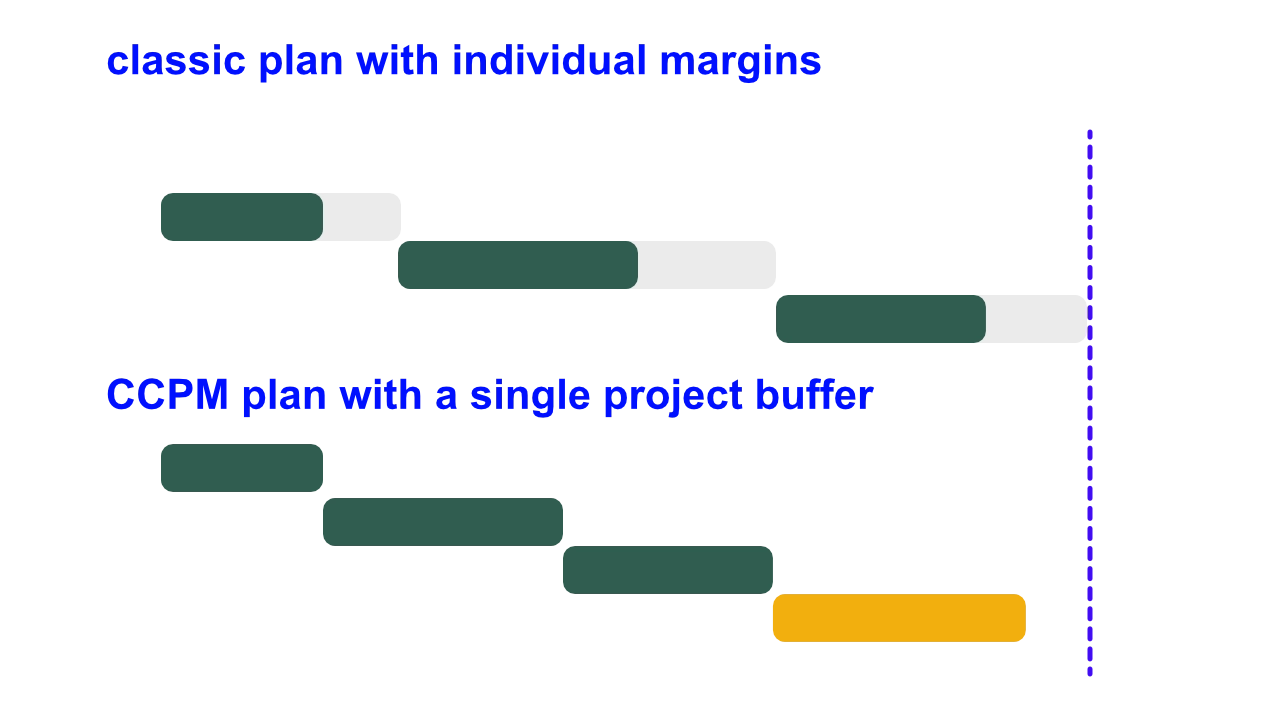
The lever: stop embedding individual safety margins inside each task. The CCPM (Critical Chain Project Management) method offers an alternative: cut local estimates and pool them into a single project buffer, statistically dimensioned. This buffer is visible, measurable, and actively managed.
Cause #3 — No Identified Critical Chain
We know the critical path. But do we know the critical chain?
The distinction is fundamental: the critical path ignores resource constraints. The critical chain accounts for the fact that the same person cannot be in two places at once.
A project can have a "comfortable" critical path on paper and still accumulate delays because a key resource is committed to another priority task. The schedule collapses without anyone formally having "failed."
The lever: explicitly identify which sequence of tasks and resources truly conditions the end date of the project. The guide on critical chain vs critical path covers this in depth.
Cause #4 — Poor Dependency Management
Projects are networks of interdependent tasks. One delayed task shifts everything that depends on it. This propagation effect is often underestimated during initial planning.
Common mistakes:
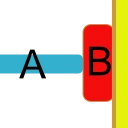
- dependencies between tasks not formally documented (so invisible in the schedule)
- floating milestones not tied to concrete deliverables
- interfaces between teams or vendors managed verbally
Undocumented dependency

Floating milestones

Informal handoffs
The lever: map dependencies before planning, not after. And formalize handoff checkpoints between teams. This is exactly the mechanism behind why projects stall despite full activity: task dependencies that stay invisible until they block everything downstream.
Cause #5 — Too Much Noise, Too Little Signal
A paradox of modern project management: the more tools, the less clarity. Teams receive updates in Slack, comments in Notion, follow-up emails, weekly status meetings — and yet nobody can clearly say whether the project is on track.
The absence of a simple, shared steering indicator is a direct cause of delays. When nobody can answer "where do we stand against the plan?", drift sets in undetected.
The lever: adopt a single project health indicator that everyone can read at a glance. In CCPM, that's the fever chart — a graph that compares, at any point in time, project progress against buffer consumption. If you haven't come across this tool yet, the guide on the CCPM fever chart is a solid starting point.
The fever chart in two sentences
A project whose buffer is consumed faster than it is advancing is in danger. A project whose buffer stays intact while progress is normal is healthy. One indicator. One decision.
Cause #6 — Social Pressure on Estimates
Less technical, equally destructive. In many teams, announcing a realistic duration is perceived as an admission of slowness. Estimates are negotiated downward during planning meetings. Resources "commit" to deadlines they know are unachievable.
The result is predictable: the delay doesn't show up at the end of the project. It accumulates silently from day one, task by task, until everyone "discovers" that the project is behind.
The lever: separate technical estimation from commercial or managerial negotiation. An estimate should be a professional act, not a political commitment. The CCPM method formalizes this separation by distinguishing the "likely" duration of a task from the project's protection margin.
Cause #7 — No Active Portfolio Steering
For organizations managing several projects simultaneously — engineering firms, consulting practices, product teams, IT departments — the ultimate cause of delays is often systemic: there is no portfolio-level steering.
Each project manager defends their resources, deadlines, and priorities. Nobody has the overall view to arbitrate. Critical resources are monopolized by the loudest projects, not the most important ones. Alerts surface too late, or not at all.
| Without portfolio steering | With portfolio steering |
|---|---|
| Each project is managed in isolation | Projects are continuously compared |
| Resources are allocated by local pressure | Assignments are arbitrated by real priority |
| Alerts arrive after the delay is already set | Tensions are visible before they derail |
| Prioritization is implicit and informal | Priority is explicit and documented |
The lever: establish a portfolio view with shared indicators — resource load, buffer status, projects under pressure. This is exactly what KairoProject enables in multi-project environments.
What These 7 Causes Have in Common
Read the list again. These causes aren't accidents. They are structural — they exist regardless of the team's goodwill.
What they share:
- Initial invisibility: they set in silently
- Cumulative effect: each cause amplifies the others
- Anticipation is possible: they're detectable early, if you know where to look
Invisible at first
Cumulative
Anticipatable
Go Further
If these causes resonate, the following resources develop each lever in more depth:
- Understand CCPM: What is CCPM? — the methodological foundation that structurally addresses most of these causes.
- Measure project tension: The CCPM Fever Chart — the visual indicator for catching drift before it derails.
- Identify the real constraint: Critical Chain vs Critical Path — why your schedule can look healthy and still slip.
- Understand why projects slip: Why Projects Slip — a complementary analysis of derailment patterns.
The most common cause is excessive multitasking: resources shared across too many simultaneous projects cannot make meaningful progress on any of them. This generates cascading delays that are hard to recover from — and the problem is often invisible until the delay is already set in.
Early warning signs include overloaded key resources, too many tasks in progress simultaneously, and no explicit time buffer in the plan. Tracking project buffers — as in the CCPM method — allows teams to detect these drifts well before they become critical.
No. They are often structural and predictable. By identifying the main constraint in your projects and protecting the critical chain with buffers, it is possible to deliver on time far more consistently. Most delays have early warning signals — you just need to know where to look for them.
The Critical Chain Project Management method identifies the true constraint chain in a project, sizes protection buffers, and tracks their consumption in real time. It reduces systemic delays caused by Parkinson's Law, inflated estimates, and multitasking — three of the most common causes listed in this article.
2 minutes · personalized result
Newsletter
Want to go further?
Get regular, actionable takes on multi-project prioritization, the Critical Chain, shared resource constraints, and steering practices.