
Project Portfolio Management: Methods, Tools and Mistakes to Avoid
What is a project portfolio, how to manage it effectively, handle shared resources, and avoid the classic mistakes that derail teams running multiple projects simultaneously.
Picture a software company with about twelve people. They are juggling five client projects at the same time. The developers are shared across all of them. The manager spends Monday mornings firefighting — deciding who works on what, explaining to clients why deadlines are slipping. Some weeks, he deliberately puts one project on hold just to try to save another.
This is not an edge case. It is the daily reality for the majority of teams running multiple projects with shared resources.
The problem is not a lack of skill or effort. It is the absence of a clear, consolidated view that would allow the right decision at the right moment — on the right project.
That is exactly what portfolio-level management provides.
What Is a Project Portfolio?
A project portfolio is the full set of projects an organisation runs simultaneously that share the same resources, constraints or strategic objectives.
The key word here is sharing. What turns a list of projects into a portfolio is not the number of projects — it is the interdependency created by shared human or material resources.

Standalone project

Programme

Portfolio
What groups projects into the same portfolio
Projects belong to the same portfolio when they share:
- human resources: the same developers, engineers, consultants or specialists working across multiple projects
- material or budget resources: shared infrastructure, a capped annual budget, common tooling
- common governance: the same manager, the same steering committee, the same decision-making level
- aligned strategic objectives: projects all contributing to the same direction, even if technically independent
This is why a twelve-person software company can have a portfolio of five client projects without any formal Project Management Office. The portfolio exists whether it is managed or not.
What most teams overlook
Portfolio management is not reserved for large organisations. As soon as two projects compete for the same resource, there is a portfolio to manage. The question is not whether you have one — it is whether you are actually managing it.
Why Manage at Portfolio Level Rather Than Project by Project?
This is where the most widespread mistake lies.
Most teams manage each project individually: one plan per project, one progress meeting per project, one status report per project. It feels natural and controlled. It is not enough.
When resources are shared, what happens on one project has a direct impact on the others. A delay on Project A ties up the developers who were scheduled for Project B. A scarce resource — a specialist, a tester, an architect — becomes the invisible bottleneck slowing down the entire portfolio.
Project-by-project management cannot see these tensions. Portfolio management makes them visible.
According to the PMI Pulse of the Profession (Project Management Institute), organisations that adopt structured portfolio management deliver significantly more projects on time and on budget than those managing project by project. This is not about company size — it is about the level of visibility into real dependencies.
The portfolio view as a decision tool
The real benefit of portfolio management is not a polished dashboard. It is the ability to decide at the right moment.
When a project runs late, the right question is not "how do we catch up on this project?" but "what is the portfolio priority right now, and which resource should I free up or reassign?"
That decision cannot be made without a portfolio-level view.
4 Classic Mistakes That Derail Portfolios
These are not management failures. They are structural traps that most teams fall into without a proper method.
1. Uncontrolled multitasking
This is the most costly and least visible mistake.
Teams switch between projects constantly, pulled in different directions by multiple project managers at the same time. Every context switch burns concentration time, introduces errors and slows everyone down.
Eliyahu Goldratt, in Critical Chain (1997), demonstrated that uncontrolled multitasking is one of the primary causes of project delay. It is not that teams are working poorly — it is that they are working on too many things at once, without ever truly finishing.
"The problem is not that people are not working hard enough. It is that they are working on the wrong things at the wrong time."
A well-managed portfolio enforces a simple discipline: one resource focuses on one task, on one project, until it is done. That requires explicit prioritisation at portfolio level — not at the level of each individual project manager.
2. Silo management, project by project
Each project has its own plan, its own meetings, its own reporting. Project managers each defend their own deadlines. Nobody has the cross-cutting view.
The result: tensions on shared resources stay invisible until they become full-blown crises. It only becomes apparent too late that the same person was scheduled at 100% on two projects simultaneously.
Silo management produces an illusion of control. Each project appears "on track" locally while the portfolio is drifting globally.
For more on this, our article on why projects slip explains the mechanisms behind project delays even when everything seems fine at the individual level.
3. The rigid Gantt with milestones on every task
The Gantt chart has been the standard planning tool for decades. It has one major flaw in a multi-project context: it places a deadline on every task, creating constant pressure at every level of the project.
When each task has a due date, two harmful behaviours emerge:
- The student syndrome: people wait until the last moment to start, because the next milestone still seems far away
- Estimate inflation: teams pad every task estimate to protect themselves, and that padding is invariably consumed
In a multi-project context, these behaviours compound and delays accumulate structurally.
The CCPM method offers an alternative: grouping safety margins into shared buffers at project level, rather than scattering them across every task. This change transforms how teams work — and how managers steer.
The Gantt chart has structural limits in a multi-project context
A Gantt can represent a single project. It struggles to represent interdependencies between projects and tensions on shared resources. For a deeper analysis, read our guide on the limits of Gantt in a multi-project environment.
4. Prioritisation by gut feel or by urgency
Without an explicit method, priority goes to whichever project has the loudest client. Or whichever project manager speaks up most in meetings. Or the last project mentioned in an email.
This is default prioritisation, not deliberate decision-making. It is opaque to teams, frustrating for clients and exhausting for managers.
Effective portfolio prioritisation is built on explicit, stable criteria: strategic contribution, pressure on the limiting resource, impact on overall delivery flow. It is decided once, known to everyone, and avoids constant last-minute arbitration.
How to Manage Resources Across a Project Portfolio
Resources are at the core of the problem. In a portfolio, the real question is never "is this project late?" — it is "which resource is under pressure, and on which project?"
Identifying the constrained resource
In every portfolio, one resource limits overall throughput: a rare profile, an under-represented skill, an expert pulled in all directions. This is what the Theory of Constraints (Goldratt, The Goal, 1984) calls the bottleneck.
The bottleneck is not the problem — it is a reality to manage explicitly. Poorly managed, it slows down the entire portfolio. Well managed, it becomes the lever for optimising overall delivery flow.
- 1Map the resources that are assigned to multiple projects simultaneously
- 2Identify which one is most overloaded relative to its real capacity
- 3Assign its tasks in portfolio priority order — not project priority order
- 4Protect this resource from uncontrolled multitasking
- 5Reassess regularly whether the constraint has shifted
Moving from workload to priority
Classic resource management thinks in utilisation rates: "this person is 80% on Project A and 20% on Project B." That is an accounting view, not a decision-making view.
Portfolio management thinks differently: which project should this person focus on right now? The answer is not a percentage — it is a clear, actionable priority.
That is the difference between a dashboard that displays data and a tool that tells you what to do.
What KairoProject makes visible from the moment you log in
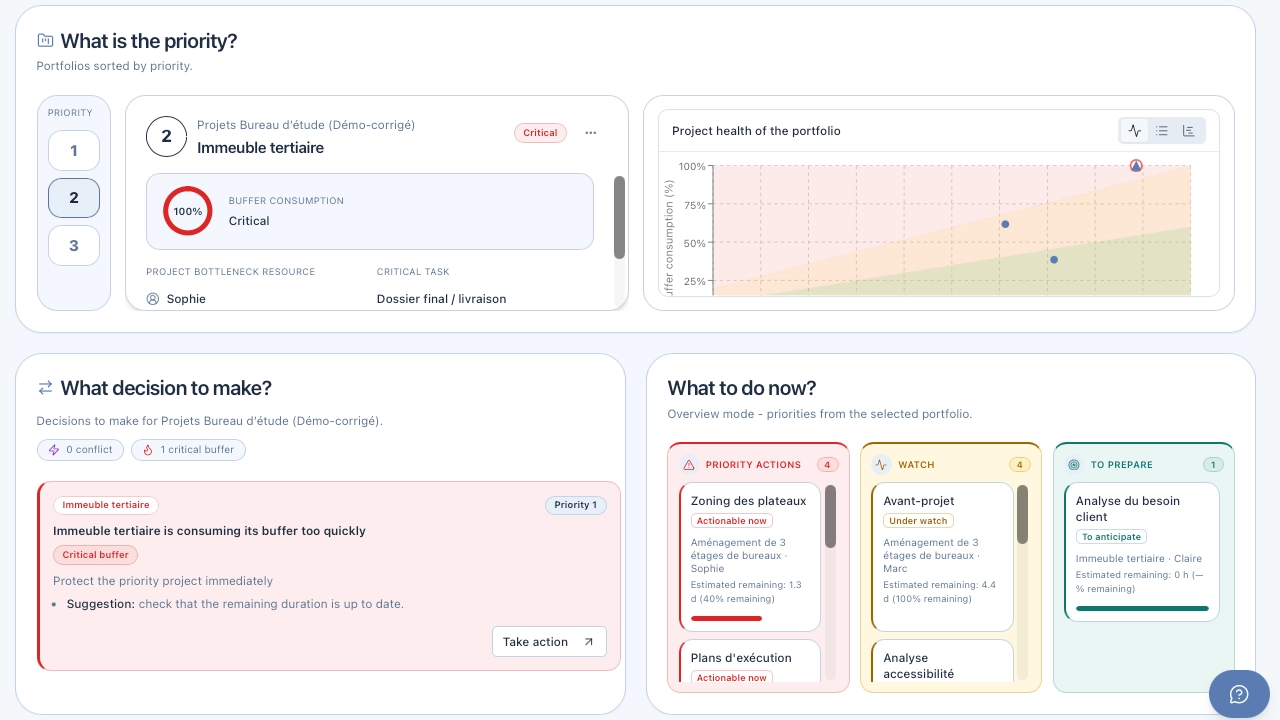
KairoProject is built around this logic. As soon as you open the tool, the dashboard shows:
- the progress status of every project in the portfolio
- identified delay causes (blocking resource, task waiting, unresolved dependency)
- priority actions to take right now
This is not a reporting tool. It is a decision tool. Instead of spending time manually assembling a portfolio view, the manager immediately has the information needed to act.
Which Method to Use for Portfolio Management?
There is no one-size-fits-all method. But some approaches have proven themselves in multi-project environments with shared resources.
CCPM applied to the portfolio
Critical Chain Project Management (CCPM), developed by Eliyahu Goldratt in Critical Chain (1997), is to date the most effective method for managing portfolios with constrained resources.
Its key principles at portfolio level:
- Stagger project launches: do not start all projects at once, even if resources appear available at the beginning
- Protect the constrained resource: assign its tasks in portfolio priority order
- Use a portfolio buffer: a shared time reserve that absorbs disruptions without destabilising the whole
- Manage by buffers, not milestones: the health indicator of a project is not schedule compliance — it is buffer consumption
To understand the foundations of this method, our complete CCPM guide explains the core concepts and their practical application. KairoProject applies this logic in practice — discover the full method.
Project staggering: an underrated portfolio decision
One of the most important decisions in a portfolio is not which projects to launch — it is when to launch them.
Starting five projects simultaneously with ten people immediately creates multitasking, resource tensions and confusion about priorities. Starting two projects, delivering them, then launching the next ones allows resources to concentrate and moves faster overall.
It is counterintuitive, but well demonstrated: fewer projects in parallel means faster deliveries.
| Approach | Projects in parallel | Average delivery time |
|---|---|---|
| Start everything at once | 5 | Long, frequent delays |
| Controlled staggering | 2–3 max | Shorter, regular deliveries |
What Portfolio Management Actually Changes
Returning to our software entrepreneur: his problem is not a lack of skill or drive. It is that he is running five projects with no view that would allow him to decide at the right moment.
He knows some projects are slipping. He does not always know which ones, or why, or what he should do differently right now.
Effective portfolio management does not eliminate difficulties. It makes them visible earlier — while there is still time to act. That is the difference between suffering delays and anticipating them.
What this entrepreneur wants — "a tool that shows him at a glance where all his projects stand and what to focus on" — is not a management fantasy. It is what any serious portfolio management tool should deliver.
To understand how steering information can itself become a problem, read our article on information overload in project management.
A project portfolio is the full set of projects an organisation runs simultaneously that share the same resources, constraints or strategic objectives. As soon as two projects compete for the same human or material resource, there is a portfolio to manage.
A programme groups projects linked by a common objective — launching a product, transforming an organisation. A portfolio groups all projects of an entity, whether linked or not, to ensure strategic coherence and resource allocation. The portfolio is the broadest management level.
Effective prioritisation relies on explicit, stable criteria: strategic contribution, pressure on the limiting resource, and impact on delivery flow. The CCPM method provides a structured framework for this. The essential thing is to avoid implicit prioritisation — by gut feel or urgency — which exhausts teams and produces inconsistent decisions.
There is no universal answer, but a practical rule: the number of active parallel projects should not exceed the real capacity of the constrained resources. In practice, reducing the number of simultaneously active projects — and delivering more of them — produces better results than starting everything at once.
Sources and Further Reading
- Eliyahu Goldratt, Critical Chain (1997) — the founding reference for the CCPM method applied to projects. Available on Google Books
- Eliyahu Goldratt & Jeff Cox, The Goal (1984) — the book that established the foundations of the Theory of Constraints. Learn more
- PMI Pulse of the Profession — the Project Management Institute's annual report on project success rates worldwide. Browse PMI reports
- Chaine-critique.com — French-language resources on the Critical Chain method. Visit the site
2 minutes · personalized result
Newsletter
Want to go further?
Get regular, actionable takes on multi-project prioritization, the Critical Chain, shared resource constraints, and steering practices.
Read next
CCPM: The Method That Explains Why Your Projects Slip (And How to Fix It)
What is CCPM (Critical Chain Project Management)? A complete guide to the Critical Chain method: principles, mechanisms, buffers, constrained resources, and multi-project steering for SMEs and engineering firms.
How to Manage Multiple Projects at Once with a Shared Team
When the same team works on several projects simultaneously, everyone is busy but nothing really moves forward. Here is the concrete method to take back control.
Why projects slip even when everyone is working hard
An operational reading of delays when priority, flow, and the constraint remain implicit, with a real-world agency case and an actionable decision framework.