
How to Manage Multiple Projects at Once with a Shared Team
When the same team works on several projects simultaneously, everyone is busy but nothing really moves forward. Here is the concrete method to take back control.
A Monday morning for an agency director
Eight-thirty. Four projects open on screen. A creative director fielding requests from three different project managers before finishing her coffee. A client calling back about a delivery promised Friday. Another project that was supposed to start this week and which nobody has had time to look at yet.
This is not an exceptional situation. For most SME leaders, it is simply Monday.
The question is not whether you manage your projects well or poorly. The question is whether you have the right tools to decide when everyone is being pulled in different directions at the same time.

Everyone is busy

No global visibility

Decisions made on instinct
This guide is designed for leaders who manage several projects with the same team and are looking for a concrete method, not theory. It covers three levels of the problem: diagnosis (why things go wrong), operational organization (how to organize differently), and a decision framework (how to arbitrate when you have to choose).
Part 1 — Diagnosis: what is really going wrong
The problem is not the number of projects
The first mistake is thinking the problem comes from having too many projects. In reality, two poorly organized projects can create as much chaos as six well-managed ones.
What creates tension is the fact that the same people work on everything at the same time, without an explicit priority between projects. The result: nobody can truly focus on anything, and each project moves at half speed.
Consider a twelve-person communications agency managing simultaneously:
- a website overhaul for an institutional client
- a product launch campaign for a retail brand
- recurring content production for two other clients
- preparation for a trade fair
The creative director is involved in all four projects. The front-end developer is split between the overhaul and the campaign integrations. The project manager juggles between four client leads.
On paper, each project has its own schedule. In practice, nobody really knows what order to work in when a single day concentrates contradictory demands.
The overloaded agency paradox
The more projects you open simultaneously, the more slowly each one moves. Reducing the number of projects active in parallel often speeds up delivery — not slows it down.
The three mechanisms that derail the portfolio
These mechanisms are not management failures. They are structural effects that appear as soon as resources are shared.
Forced multitasking
When a person alternates between several projects in the same day, they do not produce the sum of both. Each context switch — between the retail campaign and the institutional overhaul, for example — consumes mental energy, generates errors and slows real progress.
Eliyahu Goldratt, in Critical Chain (1997), showed that uncontrolled multitasking is one of the main causes of project delays. It is not that teams work poorly — it is that they work on too many things at once.
A resource in forced multitasking can lose between 20 and 40% of their effective time in transitions alone. That is time that appears in no reporting, but explains why projects slip without anyone being truly at fault.
Implicit prioritization
Without a clear priority at the portfolio level, team members arbitrate between competing demands themselves. They respond to the pressure of the moment: the most insistent client, the most present project manager, the most visible emergency.
This is not a management decision. It is an absence of decision that manifests as a default decision. And this implicit prioritization is rarely consistent with what actually matters for the business.
Invisible dependencies between projects
In a portfolio, a delay on one project can block another without anyone seeing it coming. The creative director fully absorbed by the launch campaign is no longer available to validate mockups for the overhaul. The overhaul accumulates two weeks of delay — not because of an error, but because of a dependency nobody made visible.
Individual Gantt charts do not capture these tensions. Each project looks coherent within its own schedule. The whole is fragile.
| What you see | What you do not see |
|---|---|
| Each project has its own schedule | Resource conflicts between projects |
| Everyone is working | Time lost to context switches |
| Deadlines are approaching | Cross-project dependencies propagating delays |
| Meetings multiply | The real priority that was never decided |
Part 2 — Operational organization: what needs to change
Rule 1 — Limit the number of simultaneously active projects
The most counter-intuitive rule in portfolio management is also the most effective: launch fewer projects at the same time.
As long as all projects are "active," resources are scattered across everything and finish nothing. By reducing the number of genuinely active projects, you concentrate resources, accelerate each individual project, and deliver more regularly.
The number of simultaneously active projects should be calibrated to the real capacity of the most constrained resource, not to the number of available projects or client demand.
In our agency, if the creative director can seriously manage two projects in parallel, that is the ceiling. The third project waits until one of the two is delivered before it starts.
The bottleneck rule
A portfolio's throughput is limited by its most constrained resource. There is no point accelerating everywhere: what matters is not saturating the bottleneck — and assigning tasks to it in the right order.
What KairoProject provides here: the resource load view lets you see in real time which people are overloaded, on which projects, and for how long. It immediately signals whether the bottleneck is saturated and on which project it would be most useful to concentrate capacity.
Rule 2 — Make priority explicit and known to everyone
Implicit prioritization is expensive. It generates conflicts, incoherent decisions, and permanent mental load for team members who never know what to focus on first.
Project priority must be:
- explicit: written down, displayed, known to everyone
- stable: it does not change with every meeting or every client call
- based on objective criteria, not the pressure of the moment
The most reliable objective criteria for deciding priority between projects are:
- 1Commercial or contractual constraint: which project has the most significant consequences if delayed?
- 2Safety margin tension: which project is consuming its buffer too fast relative to its real progress?
- 3Constrained resource: which project is blocking the resource that limits the entire portfolio's progress?
Once priority is decided, it applies simply: when a resource cannot do everything at once, it starts with the priority project. That is all.
What KairoProject provides here: from the moment you log in, the dashboard displays which project deserves priority attention, with the identified cause — blocking resource, consumed buffer, waiting task. It is not a list to interpret; it is a direct action recommendation.
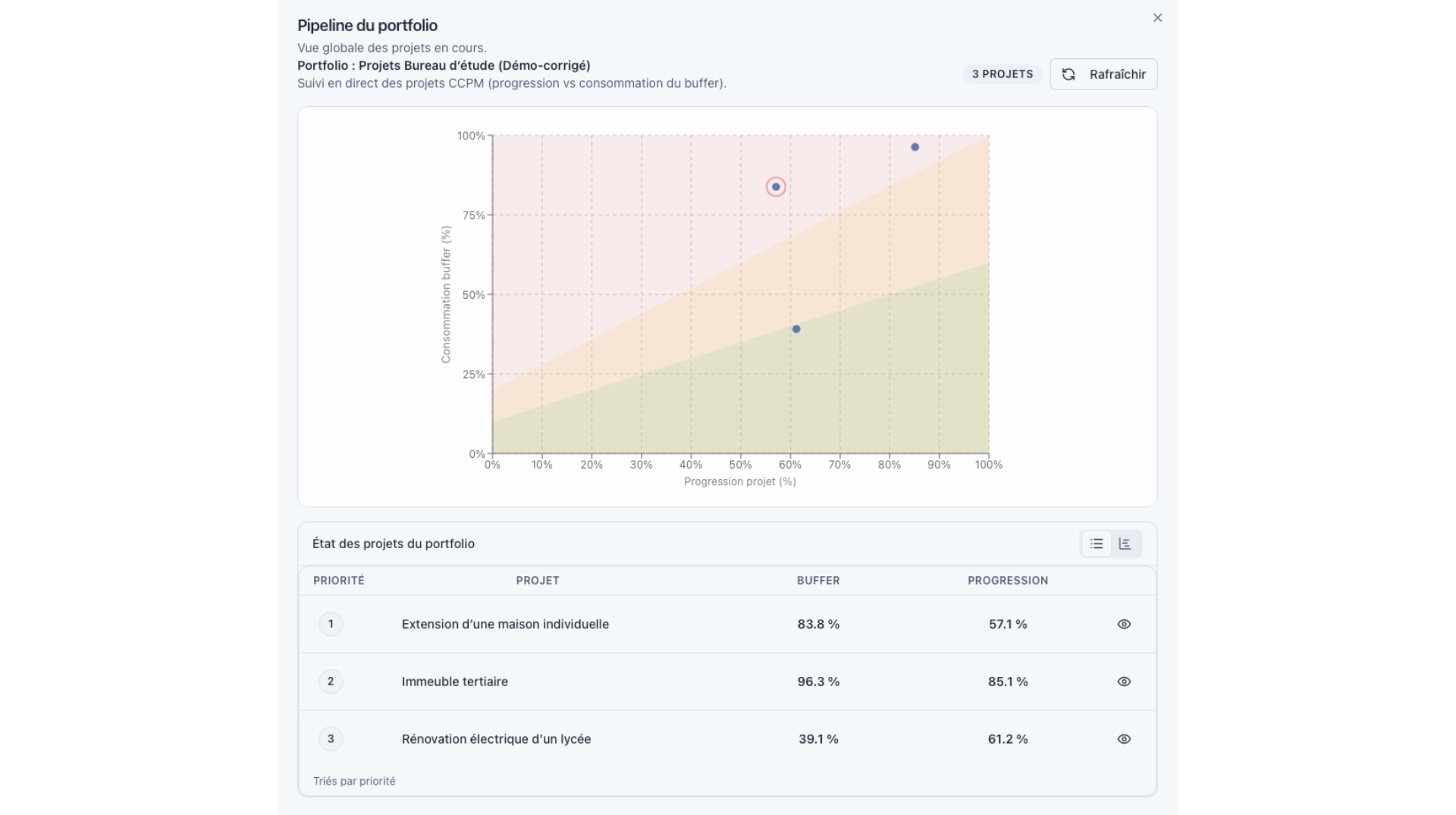
Rule 3 — Track progress by flow, not by percentage
Classic reporting asks each project manager for a completion percentage. This percentage is rarely reliable: it is often estimated loosely, it does not indicate where the real risk lies, and it does not allow meaningful comparison between projects.
What matters for portfolio management is not knowing that a project is "60% done" — it is knowing whether that project is progressing normally or starting to drift.
For this, two pieces of data are enough:
- the real progress of the project (what share of the work is done?)
- the safety margin consumption (what share of the buffer has been used?)
A project at 60% progress that has consumed 80% of its buffer is in danger. A project at 40% progress that has only consumed 25% of its buffer is healthy. The comparison between these two data points — which is what the fever chart represents — is far more informative than a simple percentage.
What KairoProject provides here: each team member updates their own estimated remaining time — not a central project manager consolidating everyone's data. This decentralized reporting model, at the heart of the CCPM method, produces more reliable and more current information, without generating additional administrative overhead. The fever chart updates in real time and positions each project in a green, orange or red zone.
Rule 4 — Protect constrained resources from multitasking
Once the constrained resource is identified — the creative director, the senior developer, the technical expert — the rule is simple: they must not be in forced multitasking.
Concretely, this means:
- 1Assign this resource one priority task at a time
- 2Do not interrupt them for non-priority requests
- 3Let other tasks queue rather than processing them in parallel
- 4Confirm the task is complete before starting a new one
This principle may seem rigid. In practice, it significantly reduces delivery time for each project — because the constrained resource moves fluidly instead of scattering its attention.
What KairoProject provides here: the resource view automatically identifies which profile is the portfolio constraint at any given moment, and on which task it should focus. When the constraint shifts to a different project, the tool signals it.
Part 3 — Decision framework: how to arbitrate when you have to choose
The typical situation: two projects need the same resource
This is the most frequent and most costly situation in terms of management time: two projects need the same person at the same moment, and you have to decide which comes first.
Without a method, the decision is made on instinct, under pressure, in favor of the most insistent client. With a simple framework, it is made in two minutes on an objective basis.
Here is the four-question decision framework:
- 1
Which project has the most significant consequences if delayed?
Contractual consequences, client impact, commercial risk. If one of the two projects has late penalties or involves a strategic client, the answer is often obvious.
- 2
Which project is the most under tension relative to its safety margin?
Compare the buffer consumed and real progress of each project. The project consuming its margin too fast is the most fragile — even if it is not yet making noise.
- 3
How much time does the resource need on each project?
If project A needs the resource for two days and project B for a week, the answer may be to finish project A (short) first before switching to B (long). Completing a task is always more efficient than interrupting it halfway.
- 4
Can the decision be clearly communicated to the team?
A trade-off decision that cannot be explained simply is a decision that will not hold. The team must understand why project A takes precedence over B — not just accept it.
Concrete example: the agency facing a difficult trade-off
Our agency receives a call on Friday afternoon from an institutional client: they want to move the website overhaul delivery forward by two weeks. Meanwhile, the retail launch campaign must deliver its final visuals next week.
The creative director cannot handle both simultaneously.
Applying the framework:
| Question | Institutional overhaul | Retail campaign |
|---|---|---|
| Consequences of delay | Strategic client, annual contract | Deadline tied to a fixed commercial event |
| Buffer tension | 45% progress, 50% buffer consumed | 70% progress, 65% buffer consumed |
| Time needed on the resource | 4 days to finalize mockups | 2 days for final visuals |
| Communicable decision | Yes: strategic client + healthy buffer | Yes: event deadline + nearly done |
Reading: the retail campaign is more advanced, its deadline is non-negotiable (tied to an event), and it only needs two days of work to complete. The institutional overhaul still has a healthy buffer despite the acceleration request. The rational decision is to finish the retail campaign first (two days), then switch to the overhaul.
This decision is not based on instinct. It is based on data. And it can be explained transparently to the institutional client.
What a decision framework changes
The value of a framework is not to give the right answer for the manager. It is to make the decision fast, explainable and consistent — even under pressure.
When should priorities be revised?
Project priorities are not fixed forever, but they should not change with every meeting. A priority revision is justified in three situations:
- a project delivers and frees up resources for the next one
- an external event changes the stakes (accelerated contract deadline, lost client, new opportunity)
- the constrained resource changes in nature (someone leaves, a skill becomes available)
Outside these situations, priority must remain stable. Priority instability is one of the most exhausting causes of disorganization in shared teams.
What KairoProject provides here: the dashboard automatically signals when a situation has changed significantly — a buffer crossing a threshold, a resource becoming available, a critical task unblocking. This avoids constantly revising priorities while ensuring no important signal is missed.
What this method changes in practice
Applying these four rules and this decision framework does not require rebuilding the entire project management system. It requires three concrete changes.
One single place to see the status of all projects
No more Monday morning meetings to manually reconstruct the overview. A suitable portfolio management tool provides this view immediately — with the status of each project, resource tension, and the recommended priority.
Regular updates from team members themselves
Each team member updates their own progress — not a project manager consolidating everyone's information. This decentralized reporting model, at the core of the CCPM method, produces more reliable, more current information, and is less time-consuming for everyone.
An explicit arbitration decision known to the team
Each week, the priority between projects is displayed and shared. Team members know what to focus on first. Contradictory requests are less frequent, and when they arise, the answer is clear.
The real benefit
The method does not eliminate the complexity of managing several projects with a shared team. It makes that complexity visible and actionable — instead of letting it accumulate until a crisis.
Going further
This guide covers the fundamentals. To go deeper on each dimension:
- Project Portfolio Management: Methods and Mistakes to Avoid — to understand portfolio management in its full scope
- How to Prioritize Multiple Projects When the Same Team Works on Everything — to go further on prioritization signals
- Why Your Gantt Chart Becomes Unreliable in Multi-Project Environments — to understand the limits of traditional tools
- Resource Overload in Multi-Project Teams — to detect and fix capacity breakdowns before they cause delays
- How to Allocate Resources When Every Project Is a Priority — for the underlying allocation method
Frequently asked questions
The key is not to try to advance everything in parallel. You need to limit the number of simultaneously active projects to the real capacity of the most constrained resource, establish an explicit priority between projects, and ensure each team member knows what to focus on first. A portfolio management tool maintains this visibility without spending hours in weekly meetings reconstructing the overview by hand.
Four questions allow you to arbitrate objectively: what are the consequences of a delay on each project? Which project is consuming its safety margin too fast? How much time does the resource need on each project? And can the decision be clearly explained to the team? These four filters are enough to prioritize without relying on instinct or the pressure of the moment.
There is no universal number. The right limit is set by the most constrained resource in the team. If the creative director or the senior developer can work seriously on two projects in parallel without excessive multitasking, two simultaneously active projects is the relevant ceiling. The third project waits until one of the two is delivered.
Every transition between two projects or two tasks consumes time and mental energy. A resource alternating between two projects in the same day can lose between 20 and 40% of their effective time in context switches. This cost is invisible in classic reporting but explains why projects slip even when everyone is working seriously.
Not necessarily at the start. But once the portfolio exceeds two or three projects with shared resources, a spreadsheet or individual Gantt chart no longer suffices: it does not cross data between projects, does not flag resource conflicts, and does not give an action recommendation. A tool like KairoProject provides this decision-ready view from the moment you log in, without reconstructing the overview manually before every meeting.
Sources and further reading
- Eliyahu Goldratt, Critical Chain (1997) — the founding reference of the CCPM method applied to projects. Available on Google Books
- PMI Pulse of the Profession — annual report on project success rates worldwide. Read the PMI reports
- Chaine-critique.com — French-language resources on the critical chain method. Visit the site
- Marris Consulting — consultancy specializing in Theory of Constraints applied to projects. Visit the site
2 minutes · personalized result
Newsletter
Want to go further?
Get regular, actionable takes on multi-project prioritization, the Critical Chain, shared resource constraints, and steering practices.
Read next
Project Portfolio Management: Methods, Tools and Mistakes to Avoid
What is a project portfolio, how to manage it effectively, handle shared resources, and avoid the classic mistakes that derail teams running multiple projects simultaneously.
How to Prioritize Multiple Projects with Shared Resources
When an engineering firm runs several projects with the same team, project-by-project prioritization breaks down. A clear method to make decisions based on real signals.
Why Your Gantt Chart Becomes Unreliable the Moment Your Projects Share the Same Resources
Gantt charts work well for isolated projects. They become misleading the moment multiple projects compete for the same people. Here is why, and what to look at instead.