
How to Reduce Project Duration Without Sacrificing Quality
Your client wants earlier delivery. Before asking for overtime or cutting review stages, read this guide. Three concrete levers to reduce project duration without sacrificing quality or burning out your team.
Your client just moved up the delivery date. Now what?
The scene is familiar in any engineering or design office: a client calls, a meeting is improvised, and twenty minutes later the conclusion lands. The delivery date has been moved up by three weeks. The project has been running for two months. Nobody asked whether it was feasible.
This isn't an exceptional situation. It's the daily reality for dozens of SMEs and engineering firms juggling multiple projects with the same teams. And when that pressure hits, the responses tend to be the same — quick, instinctive, and rarely effective.
This guide isn't about reducing duration in a crisis. It's about the more common situation: the project isn't yet late, but an external constraint has just been tightened. What can you actually do to deliver earlier, without damaging what's already been built?

The three instinctive responses — and why they fail
Before talking about what works, it's worth understanding why the first natural responses rarely deliver on their promise.
Response 1: ask everyone to work overtime
This is the most immediate solution — and the most costly. The intuition is simple: if we work longer hours, we deliver sooner. But this logic only holds if the project is linear and the entire team is working on the same sequence of tasks at the same time.
In an engineering office, that's almost never the case. Overtime increases overall capacity, but if it isn't focused on the task actually blocking the project — what's called the constrained resource — it won't move the delivery date by a single day.
Worse: it exhausts a team already juggling multiple projects, increases the risk of errors on complex tasks, and sets a precedent that's hard to manage on future projects.
Response 2: reduce validation and review stages
Cutting or shortening control steps seems logical when time is short. In practice, these stages are often where problems are caught before they become truly expensive. An error missed during the design phase can multiply the cost of correction fivefold during the construction phase.
Validation isn't waste. It's protection. Removing it transfers risk downstream — where it's most difficult and most costly to absorb.
Response 3: reduce the estimated time for a task
This third response is the most insidious. You look at the schedule, identify a task estimated at five days, and decide it will be done in three. The schedule gains two days on paper. On the ground, nothing changes — except that the person in charge now knows they'll officially be late in three days.
Reducing the estimated time for a task doesn't shorten the task. It simply shifts the moment when the delay becomes visible.
What these three responses have in common
They all act on the appearance of the schedule, not on the real constraints that determine how long the project actually takes. The result: a schedule that looks compressed, but a project that doesn't move any faster.
What actually determines how long a project takes
Before identifying the right levers, it's important to understand what actually drives the delivery date of a project.
In an engineering firm of five to fifteen people — say, a commercial electrical contractor managing several projects simultaneously — a project's duration isn't the sum of each task's duration. It's determined by the longest sequence of tasks that accounts for available resource constraints.
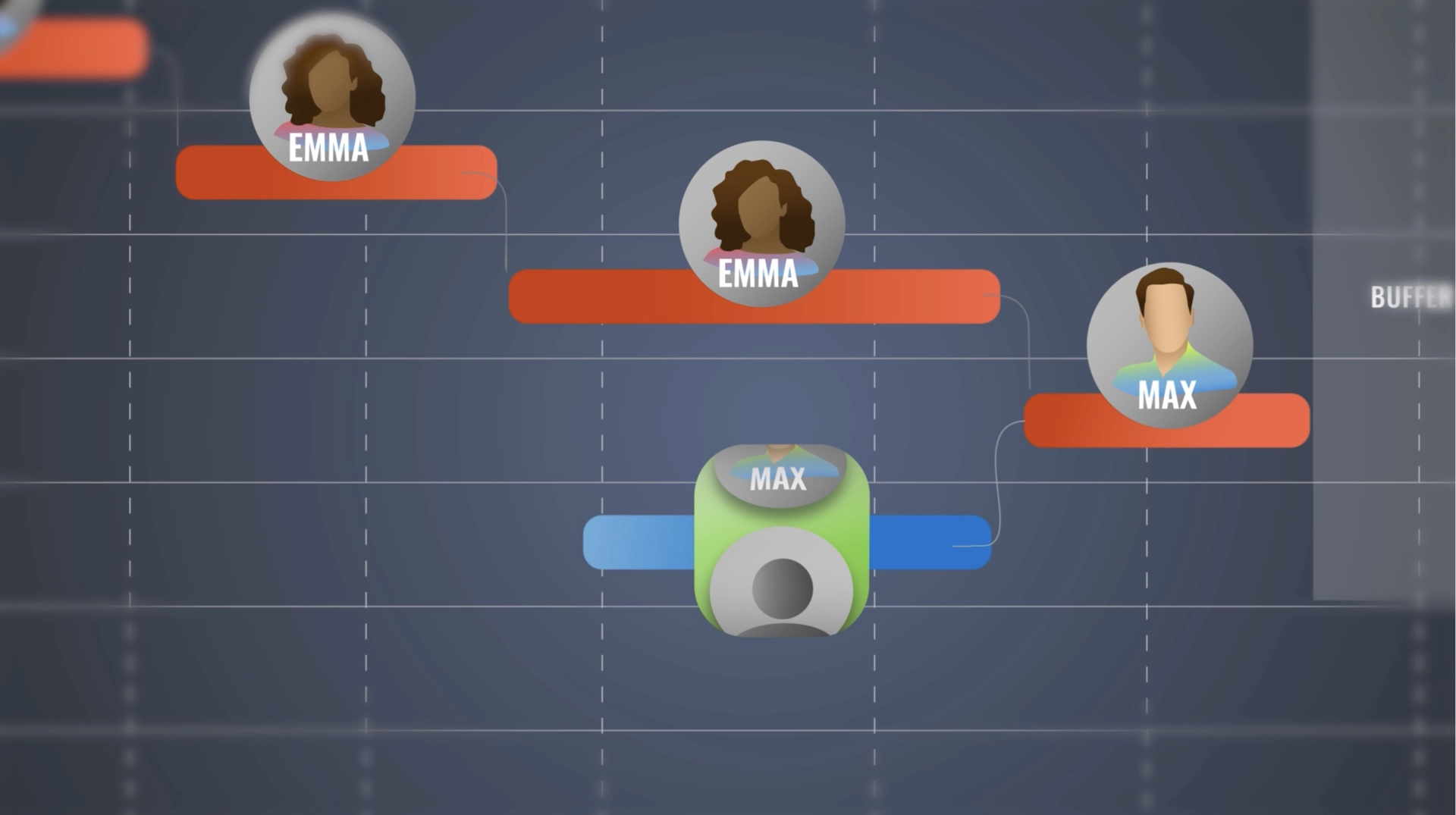
This is what the Critical Chain Project Management (CCPM) method calls the critical chain: the real sequence that drives the project's end date, integrating not just logical dependencies between tasks but also resource conflicts. Unlike the classic critical path (CPM/Gantt), the critical chain accounts for the fact that the same person can't work on two tasks at the same time.
To understand the difference between these two approaches in depth, see our guide on critical chain vs critical path.
What this means in practice: to deliver earlier, you need to act on the critical chain — not on secondary tasks, not on the overall schedule, not on individual estimates.
The 3 levers that actually work

Focus on the constraint
Resequence tasks

Reduce WIP
Lever 1 — Focus efforts on the constrained resource
In every project, there is a resource whose availability determines the speed of the critical chain. It isn't necessarily the most senior manager. It's often the most solicited profile across multiple projects: the engineer certified for a specific type of work, the design lead validating sizing calculations, the technical manager whose sign-off is required on every deliverable.
This resource is called the constrained resource. As long as it's fragmented across multiple projects, tasks, and urgent requests, it cannot accelerate the project that needs it most.
The first concrete action when facing a compression request isn't to mobilize everyone — it's to identify this constrained resource and free up its time on this specific project.
That might mean:
- temporarily deprioritizing its contributions to less critical projects;
- removing non-essential meetings that fragment its schedule;
- assigning support on the secondary tasks it's currently handling, so it can concentrate on the critical task.
The constrained resource paradox
Mobilizing everyone at 100% on an urgent project won't accelerate it if the constrained resource remains fragmented. Concentrating 80% of effort on that one resource is often far more effective than a general mobilization.
Concrete example: a commercial electrical engineering office manages three projects simultaneously. The delivery date for Project A has just been moved up by three weeks. The technical manager — the only certified profile for this type of installation — is currently active on all three projects. The most effective decision isn't to ask the whole team for overtime. It's to temporarily reallocate the technical manager to 80% on Project A, shifting their contributions to Projects B and C by two weeks — and communicating this explicitly to the teams involved.
Lever 2 — Resequence tasks to shorten the critical chain
Once the critical chain has been identified, the next step is to look at whether certain tasks can be reorganized to shorten it — without removing any step or degrading quality.
Resequencing is based on a simple observation: in any project, tasks that were planned in sequence could often be executed in parallel, or in a different order, with no real logical dependency between them. These are tasks that ended up in sequence out of habit or convenience — not out of necessity.
- 1
List all tasks on the critical chain and verify for each one whether its position in the sequence is constrained by a real logical dependency — or by a planning habit.
- 2
Identify non-critical tasks consuming time from the constrained resource that could be delegated, shifted, or run in parallel with other tasks.
- 3
Test the resequencing by moving one or two tasks into parallel on the critical chain and measuring the potential gain on the end date.
- 4
Check the impacts on dependencies across other projects in the portfolio — a task moved on one project can create a resource conflict on another.
This lever is particularly effective in projects where the initial schedule was built conservatively — which is common in engineering offices where planning is often done intuitively rather than through formal dependency analysis.
To understand how task dependencies actually affect project duration, see our guide on task dependencies in multi-project environments.
What resequencing does not do
Resequencing doesn't mean removing steps. It means reorganizing the execution order of existing tasks to free up slack on the critical sequence. The quality of each task remains intact.
Lever 3 — Reduce WIP: fewer parallel projects, each one moves faster
This is the most counterintuitive lever — and often the most powerful.
WIP (Work In Progress) refers to the number of active projects in a portfolio at the same time. When it's too high, resources are fragmented across too many projects simultaneously. Each project moves slowly — not because the team lacks skill, but because attention and availability are spread too thin.
The logic of WIP reduction is straightforward: a system that processes three projects in series delivers them faster than a system processing three projects in parallel. Resources aren't fragmented. Each project gets maximum concentration until delivery, then resources move to the next one.

In the context of a compression request, reducing WIP means concretely: voluntarily pausing or slowing down one or two less critical projects to concentrate resources on the project with the advanced deadline.
This decision is often politically difficult — every project manager defends their progress, every client seems urgent. But it's a portfolio steering decision, not a planning decision. It must be made at the right level of authority, with clear communication to the teams and stakeholders involved.
To go further on multitasking management and WIP reduction in multi-project environments, read our dedicated guide on multitasking in project management.
Why these three levers work together
These three levers aren't independent. They rest on the same logic: a project's duration is determined by its constraints, not by the sum of individual efforts.
| Instinctive response | Why it falls short | Effective lever |
|---|---|---|
| Generalized overtime | Doesn't act on the real constraint | Focus on the constrained resource |
| Cut validation stages | Transfers risk downstream | Resequence non-critical tasks |
| Reduce task estimates | Shifts the delay without removing it | Reduce portfolio WIP |
The three actionable levers share one requirement: they depend on real visibility into the project — the critical chain, the constrained resource, team load across the entire portfolio. Without that visibility, decisions remain intuitive and instinctive responses take over.
How to make this decision in an engineering office
Here is the recommended decision sequence when facing an externally imposed compression request.
- 1
Identify the critical chain of the project in question. What is the sequence of tasks that actually drives the delivery date, accounting for available resources? Not the theoretical critical path from the schedule — the real sequence on the ground.
- 2
Identify the constrained resource. Who on the team is the mandatory bottleneck on this critical chain? How many projects are they currently active on? What is their actual workload?
- 3
Evaluate the potential gain from resequencing. Are there tasks on the critical chain that could be parallelized or reorganized without a binding logical dependency? How many days would that save?
- 4
Decide on an acceptable WIP level. Can one less critical project be temporarily paused or slowed to concentrate resources on this project? Who needs to make that call, and how should it be communicated?
- 5
Communicate the decision explicitly. Schedule compression doesn't happen silently. It involves visible trade-offs — a resource reallocated, a project paused, a sequence modified. Without clear communication, teams continue on their current trajectory.
This sequence can be completed in one to two hours if steering data is available. Without visibility into resource load and the real state of projects, it can take several days — during which the deadline keeps closing in.
What the right project management tools enable
Schedule compression is first and foremost a decision. But it can only be made correctly if the necessary information is available without delay: who is constrained, on which project, with what impact on the rest of the portfolio.
A project management tool suited to multi-project environments must answer these questions in minutes, not days. That's the difference between a proactive decision — made at the right time, with the right levers — and a late reaction, which is almost always more costly.
KairoProject is designed to make this information immediately accessible: the critical chain of each project, the constrained resource's workload, and the comparative tension across all projects in the portfolio. When a compression request arrives from outside, the tool lets you identify in a few clicks which lever to pull first — and measure its impact before deciding.
Schedule compression as a test of project steering maturity
How a team responds to an externally imposed deadline compression reveals the maturity of its steering practice. A team with the right data makes a structured decision in a few hours. A team navigating on intuition takes several days to converge — and often ends up combining all three instinctive responses at once.
To go further on portfolio management and trade-off decisions across projects, read our guide on project portfolio management.
Frequently asked questions
Yes, in most cases. The most effective levers — focusing on the constrained resource, resequencing tasks, reducing WIP — don't require additional resources. They require an explicit decision on priority and a reallocation of existing resources.
By identifying the critical chain and the available buffer. If the project still has unconsumed buffer, some of that slack can be used to absorb the compression. If the buffer is already depleted, compression necessarily requires one of the three actionable levers described in this guide.
Make visible what the compression actually entails: which resource is being reallocated, which other project is impacted, what quality risks are being taken. An informed client decision is better than a promise kept through overtime and undetected errors. Transparency about constraints is professional steering practice, not an admission of weakness.
Yes — and that's precisely when it's most necessary. When everything seems urgent, nothing is truly prioritized. WIP reduction forces an explicit answer to which urgency comes first, based on objective data rather than the intensity of incoming requests. To learn more about prioritization in multi-project environments, read our dedicated guide.
No. The three levers described here can be applied regardless of the planning method used. CCPM provides a formal framework for identifying and measuring them, but the underlying logic — act on the constraint, reorganize tasks, reduce multitasking — is universal.
Sources and further reading
- Eliyahu M. Goldratt, Critical Chain (1997) — the founding work of the critical chain method, formalizing the concepts of constrained resource and project buffer. Google Books
- Project Management Institute, Pulse of the Profession — annual report on project success rates and causes of schedule slippage. pmi.org
- Marris Consulting — a reference firm for CCPM application in industrial and multi-project contexts. marris-consulting.com
2 minutes · personalized result
Newsletter
Want to go further?
Get regular, actionable takes on multi-project prioritization, the Critical Chain, shared resource constraints, and steering practices.
Read next
Reducing Multitasking in Your Projects: The Right Management Approach
Multitasking in project management is not a concentration problem — it is the symptom of a portfolio without clear rules. Here is what the executive can decide, and what the project manager can do day to day.
How to Prioritize Multiple Projects with Shared Resources
When an engineering firm runs several projects with the same team, project-by-project prioritization breaks down. A clear method to make decisions based on real signals.
Project Buffers Are Not Waste — They Are Risk Absorbers
Compressing schedules doesn't reduce project risk — it removes the capacity to absorb it. Why buffers are essential to realistic project planning.